
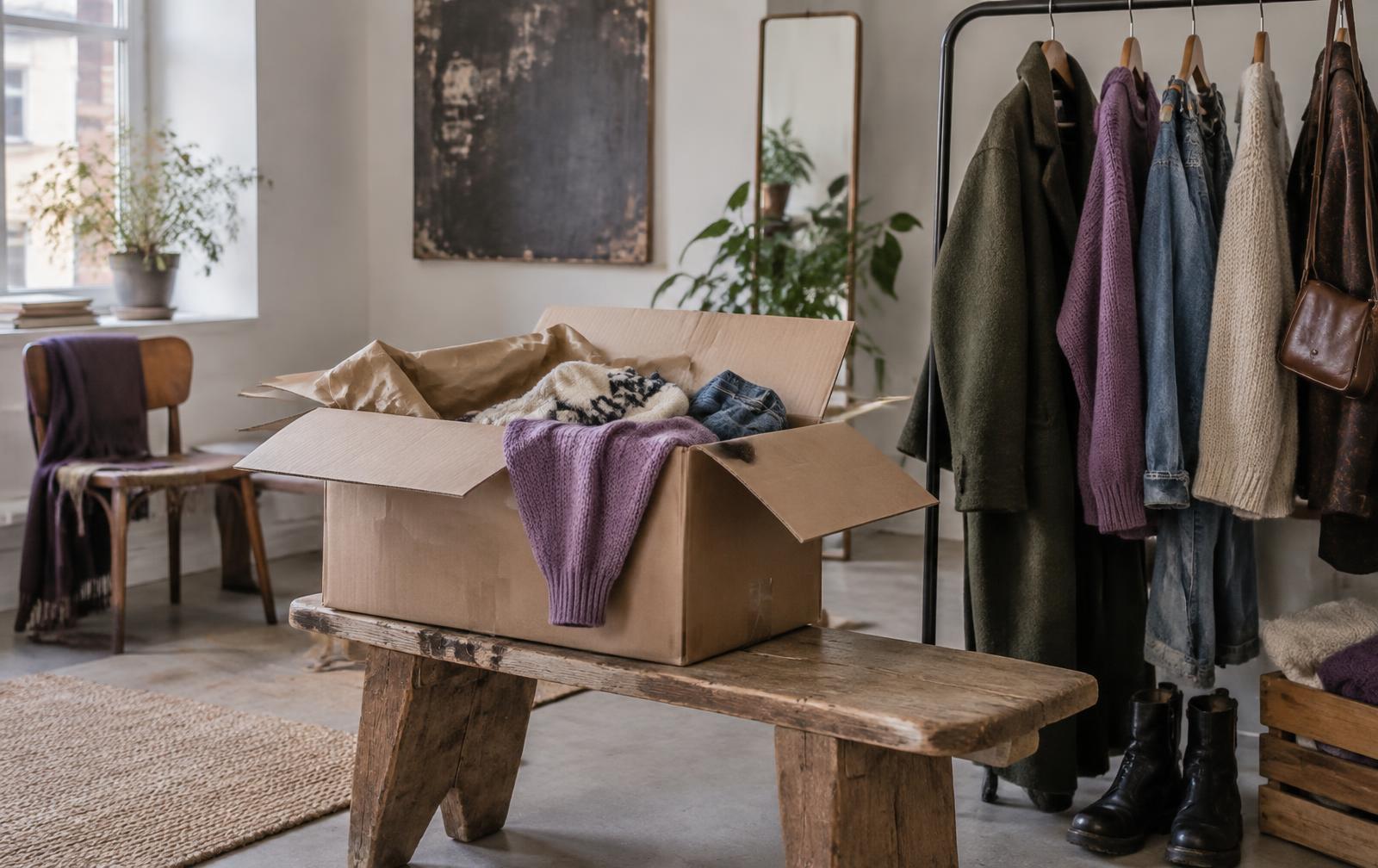
On 10 September, right in the middle of Second Hand September, Oxfam France published a report with a headline figure that travelled fast: charity shops pollute five times less than Vinted. If you've spent the last few years feeling mildly virtuous every time a parcel of someone else's knitwear lands on your doormat, that one probably stung.
So, is buying on Vinted sustainable? Mostly, yes, with a caveat. The five-times figure is real, but it compares one kind of second hand with another, not second hand with new. And that second comparison is the one that matters most when you're deciding how to get dressed.
That said, where you buy is only half the story. The other half is how much we buy: EU textile consumption rose from 17 kg to 19 kg per person between 2019 and 2022, according to the European Environment Agency.
What Oxfam actually measured
The report, Seconde main : le réemploi solidaire, la seconde chance de la mode, compares three ways of buying second hand in France. According to the figures picked up by the French press, getting 5 kg of second-hand clothing to a buyer produces around 0.6 kg of CO₂e through a charity shop, 2.9 kg through a commercial thrift chain and 3.1 kg through an online platform like Vinted. The difference is mostly logistics: a charity shop sells local donations to local shoppers, while an app sends each order in its own parcel.
Oxfam's wider argument goes beyond carbon, too. Charity shops fund social projects and local jobs, and the report warns that six in ten second-hand garments in France now go through profit-driven channels. Both points are worth taking seriously. But the headlines mostly skipped one comparison the report itself makes: how second hand stacks up against buying new.
| How you buy | CO₂e per 5 kg of clothing | Source |
|---|---|---|
| Charity shop | ~0.6 kg | Oxfam France, 2026 |
| Commercial thrift chain | ~2.9 kg | Oxfam France, 2026 |
| Online resale (Vinted and similar) | ~3.1 kg | Oxfam France, 2026 |
| Buying new | up to ~160 kg | Estimate based on Oxfam France's “up to 270 times” figure |
The comparison the headlines skipped
According to Oxfam's report, buying 1 kg of clothing in a solidarity shop emits up to 270 times less CO₂e than buying 1 kg new, and a single new t-shirt carries roughly the same footprint as 50 kg of reused clothing. Using Oxfam's figures as a rough calculation, the online resale figure would still imply an emissions footprint around 50 times lower than new. That's an estimate rather than a figure Oxfam reports directly, so it should be read as indicative rather than exact, but the scale is hard to miss.
The gap between a charity shop and an app is a couple of kilos of CO₂. The gap between either of them and buying new is far bigger.
Vinted's own data points the same way, with the usual caveat that it's the company's own reporting. It says that even after delivery, each second-hand item bought on the app avoids an average of 2.39 kg of CO₂e compared with buying new, and Vinted's 2025 impact report puts the total at 1,607 kilotonnes avoided in a year. It's also open about its weak spot: 94% of its operational emissions come from delivery, which is part of why lockers and pickup points keep spreading across its markets, Madrid included.
Does it actually replace buying new?
This is the fairest question in the whole debate, and Oxfam asks it. Eloïse Bazin, an advocacy officer at Oxfam France, put it this way: second hand "is a good solution if it replaces a new purchase." If it doesn't, it's just more shopping.
Vinted's own survey data suggests that it often does. The company reports that 76% of orders on the platform replaced a new purchase, and that 88% of members check Vinted before considering buying something new. Those figures come from Vinted's climate modelling and a survey of more than 64,000 of its members, so they're a good sign rather than proof, but they describe a habit plenty of us recognise: you search the app before you search the shop.
Resale can change how people buy in the first place, too. In the same report, 41% of Vinted members say they think about resale value before buying something, and 56% say they look after their things better because they know they can sell them on.
Second hand only beats new when it's easy enough to choose over new. Online resale made it much easier.
Why online resale can reach clothes that might never reach a charity shop
The problem is even bigger at the other end of the wardrobe. The European Environment Agency estimates that EU citizens generated around 16 kg of textile waste per person in 2022. More than twice as much textile waste went into mixed household waste as was separately collected for reuse and recycling: 11.1 kg versus 4.6 kg per person. Oxfam GB's State of Style 2026 report found that one in five people throw clothing away rather than repair, donate or resell it.
Even what does get donated doesn't always stay local: as I've covered before, a nine-city study found that between a third and nearly all of what charities collect never gets resold where it was given. That's not a knock on charity shops. They do brilliant work, and if there's one round the corner, it's a great place to shop. It's a reminder that no single channel can handle Europe's wardrobes alone, and that different channels do different jobs.
- Online resale puts a price on things people might not think to donate: barely worn trainers, the designer bag, the coat that was an expensive mistake.
- It matches very specific items to very specific buyers across a whole country, instead of hoping the right person walks past the right rail.
- It gives sellers a reason to keep clothes in good condition, because good condition is what gets paid.
How to make your Vinted habit greener
- Bundle. Buying three things from one seller means one parcel instead of three.
- Choose a pickup point or locker over home delivery when you can, so the courier drops a whole round in one place instead of stopping at every door.
- Check the measurements, not just the size on the label, so the piece doesn't have to travel again.
- Let it replace something. The more your second-hand buys stand in for new ones, the bigger the saving.
So, is buying on Vinted sustainable?
Compared with buying new, yes. On Oxfam's own numbers, it's one of the lower-impact ways to get dressed. A charity shop round the corner does better on transport, and it's always worth supporting. And the lowest-impact option of all is still the one that's already in your wardrobe. But for most people, most of the time, the real choice isn't a charity shop or an app. It's second hand or new.
Resale is also growing fast. ThredUp's 2026 Resale Report projects the global second-hand market will reach $393 billion by 2030, growing about twice as fast as fashion overall. Whether that's good news depends on the same question as above: how much of it replaces new. If you want the longer version of where your old clothes actually end up, I've written that separately.
Where Ealyx fits
This is where the other side of resale matters: selling has to be easy enough that people actually do it.
Taking photos, writing listings, choosing prices, answering messages and keeping track of multiple platforms is enough friction to make a wardrobe clear-out feel like a second job. And when selling feels like too much effort, perfectly wearable clothes can end up donated, stored indefinitely or thrown away.
That's the problem Ealyx is built around. Take a photo of your piece and our reselling agent creates the listing and puts it in front of buyers on the platforms where people already shop, including Vinted and eBay, while handling the rest of the selling process.
The easier it is to sell a piece, the more likely that piece is to get a second owner.
If you're still not sure what to do with a pile of clothes, here's how to decide whether to donate or sell. If you'd rather list things yourself, here's how to sell on Vinted without leaving money on the table. And if you're on the buying side, here's which secondhand pieces are worth buying.
Quick answers
Is buying on Vinted better for the environment than buying new? In most cases, yes. Vinted says each second-hand item bought on the app avoids an average of 2.39 kg of CO₂e compared with buying new, even after delivery. On Oxfam France's 2026 figures, online resale comes out at up to around 50 times lower than new, as long as it replaces a new purchase.
Why does Oxfam say Vinted pollutes five times more than charity shops? Mainly because of delivery. Oxfam France's September 2026 report puts online platforms at around 3.1 kg of CO₂e per 5 kg of clothing, against around 0.6 kg for charity shops. Both are a small fraction of the footprint of buying the same clothes new.
What is the most sustainable way to buy second hand? Buy less overall, and make your second-hand purchases replace new ones. Local charity shops have the lowest transport footprint, and online you can cut it further by bundling orders from one seller and choosing pickup points or lockers.
Does buying second hand on Vinted replace buying new? Often, according to Vinted. The company reports that 76% of orders on the platform replaced the purchase of a new item, and 88% of members check Vinted before buying something new, though these are self-reported survey figures.